First you have to determine what likely to happen problems your repair kit will solve, and then figure out what tools you will need to solve those problems. That's why a field repair kit should be as small as possible, while at the same time containing all the tools you need to repair all the various things you'll need to repair on the trip. Lightweight outdoor equipment demands a lightweight repair strategy.
Start with failures, not tools
The easiest way to end up overpacking a repair kit is to start shopping for tools before you decide on the problems you want to fix. Go through your actual gear and imagine what could fail. A buckle breaks, a cord pulls out of a sewing hole, a seam unravels, fasteners come loose. It's quite possible that a number of these can be solved with one or a few powerful tools.
Make a short list for yourself that goes through all your gear in detail. For each important piece go through the worst point that could fail and describe the simplest repair for that failure point. How do you fix a torn seam? How do you stop a clip from coming loose? The result of such an analysis can be quite surprising. Are there really so many parts you need to carry in your repair kit? Maybe not.
Build around a few versatile materials
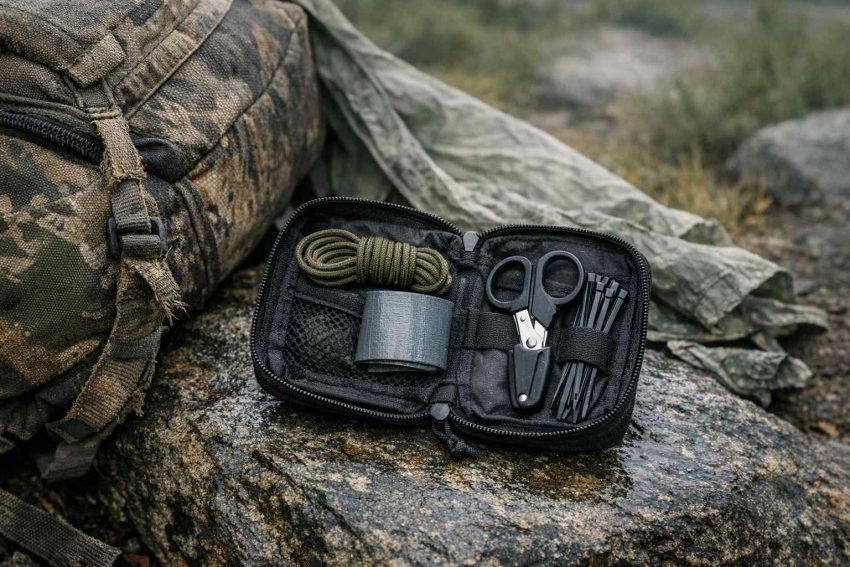
To be considered for carrying, repair tools must be able to solve more than one problem. Strong cord can be used to hold a loose repair part, as an emergency tie-off, or even as an adjustment to something that has become too tight. Likewise, repair tape can be used to patch tears, cover rough spots, or even to hold together separated parts for the time being when a more proper fix can be made later.
Adhesives work best on clean, dry surfaces. Typically, repair tape does not stick to wet, dirty or very stretchy fabrics. Also, patches should not be applied in such a way that they cover zippers etc. That can cause more problems than you started with. All materials for repairing packs should be neatly wrapped up in a clean, compact package (such as a clean Alt Berg poncho or similar fabric stuff sack) ready for use. A mass of tangled cord, tape etc. is often worse than useless in the dark, cold and rush of an emergency repair in the field.
Choose tools by task and consequence
A small pair of scissors or even a compact cutting tool can be very useful for a field repair kit. Look for something that will clean cut cord, tape, and loose threads. In your pack, a blunt or even protected scissors may be better than a sharp pointed pair. The tool should be easily managed by you, and perhaps turned upside down to cut. A sharp pointed scissors would be better left at home for more precise work such as trimming a path through a thicket.
While a multi-tool is sometimes a good choice for a repair kit because it contains so many functions, don't choose it just because it is a multi-tool. You will be adding weight and bulk to your kit. And some multi-tools are so awkwardly designed that they cannot be opened with cold hands. Try to choose the smallest tool possible that will have the function you need. Do not carry duplicate blades or other tools – if you have a buckle that will fail, you might carry a spare buckle for that item, but not a whole collection of other buckles as well.
Match the kit to the trip
How much do you anticipate to be unable to repair? Short trips close to vehicles need little in repair, in terms of weight. Items such as repair tape and cord, and a means to cut said cord are perhaps best for short, proximity-to-vehicles type trips. Longer trips, into the remote backcountry, and exposed to weather, require consideration to items that can be spare'd, such as extra buckle's, a needle and some thread, various fasteners, and perhaps a more heavy-duty multi-tool.
While most outdoor equipment is quite light weight, that does not mean that one can 'cut' corners when it comes to repairs in the back country. A single part missing can render essential items useless. While comfort vs. tripending failures is worth consideration, it is generally not wise to carry overly heavy repair items for delicates, as even better repair items for said items can provide equivalent or better results and be much lighter in the end.
Keep repairs temporary when they should be
Reminders of how to do a repair and what was done to fix something are a big part of the home maintenance for a repair kit. Make sure to empty out the contents of your repair kit after your trip and go through all of the repair attempts made while in the field. Clean off any residue from repair adhesives and test out the repaired area to make sure it is functioning back to normal.
When you get back to your home, unpack the pouch containing your repair articles, inspect what you have repaired and clean them from dirt and residue from adhesives. Replace consumed items and test the original parts for your gear. You will soon enough find out which of your repair articles are useful and which you have been carrying for a long time without any real purpose.
Avoid the common packing mistakes
The biggest error with many repair kits for the field is that they stock solutions to problems that do not have corresponding compatible parts for the specific piece of equipment. Pack separate replacement parts for your equipment and check them against the actual item before you pack them. Store a sample of each part along with a note to explain how you identified it if necessary.
Do not rely on the repair kit for your maintenance. Inspect all seams, straps, closures, and attachments prior to departure, clean gear according to the manufacturer's care guidance, and replace any obvious failing components prior to going into the field. Different activities and pieces of equipment have different requirements and safety considerations, so be sure to check the current manufacturer's guidance as well as any relevant official regulations for your activity.
Don't bury your repair kit at the bottom of your pack. Store it where it can be easily reached and put it in a pouch that makes it obvious when something is missing. The best of the compact repair tools are those you can identify quickly, use safely and return to their storage place in your pack after use. In summary, a small repair kit is worth carrying if it is specific, can be easily found, is used and then returned to its storage place and looked after.